

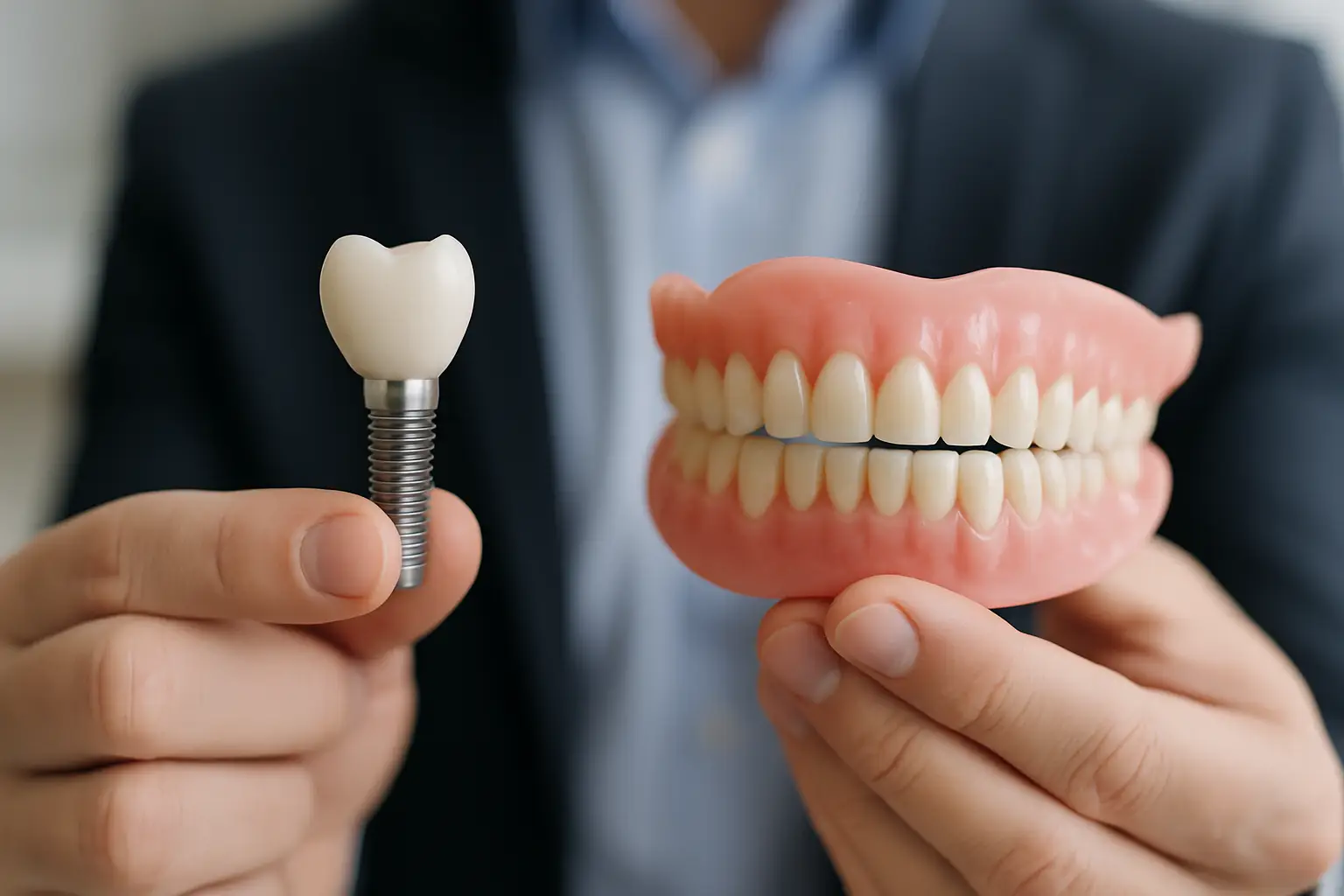
You notice it first at dinner. Chewing shifts from automatic to careful. Then come the smaller moments – laughing without thinking, speaking clearly in meetings, biting into an apple. When teeth are missing or unstable, the question isn’t only “What looks good?” It’s “What can I rely on every day?”
That’s exactly what people mean when they ask: feste zähne oder herausnehmbar. Fixed teeth (often on implants) and removable options (dentures, partials, implant-retained overdentures) can both be excellent – but they serve different lives, different anatomy, and different priorities.
What “fixed” and “removable” really mean
“Fixed” usually means a restoration that you don’t take out yourself. It can be a bridge supported by implants, or a full-arch solution where a set of teeth is securely attached to implants. In many cases, you still clean it thoroughly, but it stays in place.
“Removable” means you can take it out for cleaning. This includes classic dentures (full or partial) and implant-assisted dentures that click onto implants for better hold.
The best choice is rarely about a single feature. It’s about stability, bone health, comfort, maintenance, timeline, and the level of “peace of mind” you want when you eat and speak.
The real-life differences patients feel first
People often come in saying they want “the best.” The more useful question is: what feels like “best” for your daily routine?
Fixed teeth feel closest to natural teeth in terms of bite force and confidence. There’s no taking them out, no adhesive, and typically less movement when chewing. For many adults with major tooth loss, that stability can be a turning point – socially and functionally.
Removable options can feel lighter and simpler at first, especially if surgery isn’t appealing. They can also be a practical step when the mouth needs time to heal or when budget needs to be staged over time. The trade-off is that removable dentures rely on gums and bone for support, and that support can change over time.
Feste Zähne oder herausnehmbar: who tends to prefer which?
This is where “it depends” is not a dodge – it’s honest dentistry.
If you want maximum stability for chewing, speaking, and daily confidence, fixed implant-supported teeth are often the first choice. They’re especially attractive if you’ve had years of loose teeth, advanced wear, or dentures that move.
If you want a lower initial investment, a removable solution can be a reasonable starting point. If you’re medically not a candidate for surgery right now, removable options may also be the safest path.
A large group lands in the middle: they want removable for cleaning comfort, but they also want real stability. For them, implant-retained overdentures (the “snap-on” concept) can be the best compromise.
Fixed teeth on implants: what you gain, what you give up
Fixed implant solutions can be life-changing, but they’re not “set and forget.” They require planning, precision, and long-term maintenance.
Stability and bite performance
Implants anchor into the jawbone, which means the biting forces go into a stable foundation. Patients typically notice they can chew more confidently and stop “testing” food before committing.
Comfort and confidence
Without a bulky palate plate (often present in upper dentures), many people experience more natural speech and taste. For work, travel, and social situations, not having to remove teeth can feel like regaining normalcy.
Bone support and long-term structure
When teeth are missing, the jawbone can shrink over time. Implants help stimulate the bone in a way similar to natural tooth roots. That doesn’t mean bone never changes, but it often supports better long-term stability compared with gum-supported dentures.
The trade-offs
Fixed solutions generally require surgery, detailed diagnostics, and higher upfront cost. They also demand disciplined hygiene. Even though implants can’t get cavities, the gums around them can become inflamed if plaque stays. Long-term success depends on professional cleanings and home care.
Removable teeth: not “second best,” but a different strategy
Removable dentures have improved a lot – materials, fit, and esthetics are better than many people expect. But removable is still a different experience than fixed.
Speed and flexibility
A removable denture can often be made without implant surgery. It can be adjusted as your mouth changes, and it’s sometimes used as an interim solution while planning a more definitive restoration.
Easier daily cleaning for some patients
Being able to remove the prosthesis can make cleaning feel more manageable, especially for people with limited dexterity. That said, the gums and any remaining natural teeth still need careful hygiene.
The trade-offs
Classic dentures rest on soft tissue. Even with a good fit, movement can happen, particularly in the lower jaw. Pressure spots can develop. Over time, as bone changes, relines or remakes may be needed to keep the denture stable and comfortable.
The “middle way”: implant-retained overdentures
If the phrase “I don’t want it to move” describes you, but you also want something removable for cleaning, an implant-retained overdenture is often the sweet spot.
A few implants (commonly two in the lower jaw, sometimes more depending on anatomy and goals) can provide a secure attachment. The denture “snaps” into place. Patients often describe the difference as immediate – less lifting, less shifting, more confidence.
The main compromises are that you still have a removable appliance and may still have some bulk, especially in the upper jaw if the palate needs coverage for support. Attachments also wear over time and require periodic maintenance.
How dentists decide: the factors that actually matter
A high-quality recommendation is not based on preference alone. It’s based on measurable findings.
Bone and anatomy
Implants need sufficient bone volume and quality, or a plan to build it. In modern practices, 3D imaging can show precisely where bone is available and how to place implants safely around nerves and sinuses.
Gum health and inflammation control
Whether you go fixed or removable, gum health is non-negotiable. If there’s active periodontal disease, it needs to be stabilized. Implants placed into an inflamed environment carry more risk.
Bite forces and habits
Clenching, grinding, and bite imbalance influence design choices. Some patients need protective night guards or specific materials to reduce stress on implants and restorations.
Time constraints and desire for speed
Some people can’t wait months without dependable teeth. Others prefer to stage treatment slowly. Your schedule matters, and good planning respects it.
Budget and long-term planning
It’s not only “What does it cost today?” It’s also maintenance, expected replacements, and how stable the solution stays over years. A removable denture can be less expensive upfront, but if it needs frequent remakes due to fit changes, the long-term picture can shift.
Where “Fixed Teeth in a Day” fits in
Many adults assume implant dentistry always means a long period without teeth, or months with temporary solutions that feel like a compromise. That’s not always true.
With careful 3D planning, guided surgery, and a coordinated in-house lab workflow, it can be possible to place implants and deliver an immediately loadable fixed provisional on the same day for suitable candidates. The key phrase here is “suitable candidates.” Immediate loading requires stability at placement and a plan that respects biology.
This is exactly the type of case where a digitally organized implant center can reduce uncertainty: the imaging, the surgical plan, and the prosthetic design are aligned before the first step. If you’re considering feste zähne oder herausnehmbar and speed is a top priority, ask specifically whether immediate fixed temporaries are realistic in your situation – and what criteria the team uses to decide.
What to ask at your consultation (so you leave with clarity)
You don’t need to know dental terminology to make a strong decision. You do need a plan that is transparent.
Ask what the diagnosis shows in 3D and how that affects options. Ask whether bone augmentation or sinus lift is expected, and how that changes timeline. Ask what your maintenance looks like: professional hygiene intervals, at-home cleaning tools, and what “normal” wear items might need replacement.
Also ask what your temporary phase will feel like. Many patients accept surgery and cost more easily when they understand how they’ll look and function during healing.
If you’re in Leipzig and want a time-efficient workflow with digital planning and restorations made locally, Zahnzentrum Leipzig – Dr. Krafft MVZ shares details on its treatment approach and online appointment system at https://zahnarzt-leipzig.com/.
The decision that usually brings the most relief
Most people don’t regret choosing the option that makes them forget about their teeth during the day. Not the option that looks best in a brochure, or the one that sounded simplest at midnight after too much Googling.
Your best answer to feste zähne oder herausnehmbar is the one that fits your health, your schedule, and your tolerance for maintenance – and that gives you the quiet confidence to eat, speak, and smile without negotiating with your teeth.