

A single missing tooth can look like a small problem – until chewing feels “off,” food traps start showing up, and the neighboring teeth begin to shift. If you’re comparing options, you’re usually deciding between two proven solutions: a dental implant (Implantat) or a fixed dental bridge (Brücke). The better choice depends less on opinions and more on your anatomy, your timeline, and what you want long-term.
Implantat oder Brücke – was ist besser?
Both can restore function and aesthetics at a high level. The key difference is what each option asks of your mouth.
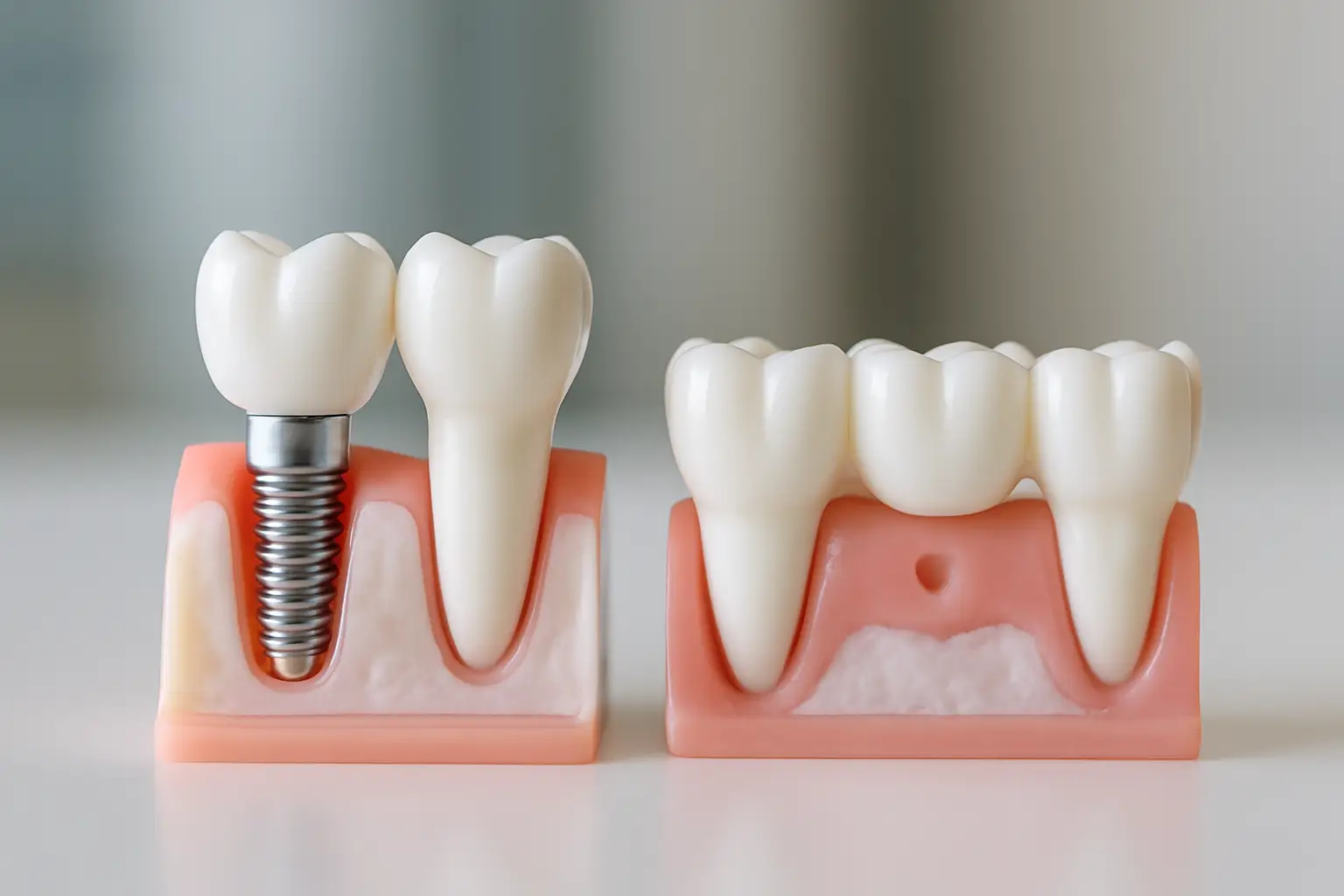
A bridge replaces the missing tooth by using the two neighboring teeth as supports. Those teeth are shaped down and crowned, and the “false” tooth (pontic) is connected in between.
An implant replaces the missing tooth at the root level. A titanium or ceramic implant is placed in the jawbone, integrates with bone, and then carries a crown. The neighboring teeth are typically left untouched.
So, “implantat oder brücke was ist besser” becomes a question of biology and engineering: Do we want to lean on adjacent teeth, or do we want to rebuild the missing tooth as an independent unit?
The decision drivers that actually matter
Most people first ask about cost and time. Those are important, but four other factors usually decide what’s best clinically.
1) Condition of the neighboring teeth
If the teeth next to the gap already have large fillings or need crowns anyway, a bridge can be a very efficient solution. You’re not “sacrificing” healthy tooth structure because those teeth require restoration regardless.
If the neighboring teeth are intact and healthy, an implant is often the more conservative option. You avoid grinding down two teeth that might otherwise last decades without crowns.
2) Bone and gum stability over time
This is where implants have a unique advantage. When a tooth root is missing, the jawbone in that area tends to shrink over time because it no longer gets normal chewing forces. An implant can help preserve bone by reintroducing functional stimulation.
A bridge does not place forces into the bone in the same way, because the missing tooth space is “floating” between crowned teeth. That means the bone under the pontic may continue to remodel and recede. In the aesthetic zone (front teeth), that can matter for the gumline and the natural look.
3) Hygiene and maintenance
A bridge is fixed (not removable), but it still needs special cleaning underneath the pontic with floss threaders, interdental brushes, or water irrigation. Patients who already struggle with flossing often find bridge hygiene harder than they expected.
Implants are cleaned like teeth, but they require consistent gum care and professional maintenance. Implant crowns can’t get cavities, but the gums around implants can become inflamed (peri-implant mucositis) and, if neglected, progress to peri-implantitis.
If you know you want the easiest daily routine, talk honestly about your hygiene habits. The “best” option is the one you’ll maintain consistently.
4) Bite forces and risk profile
Back teeth handle stronger chewing forces. In molar areas, implants often perform very well because they restore function without putting extra stress on adjacent teeth.
Bridges can also work in back areas, but the load is shared by the supporting teeth. If those teeth have cracks, root canal treatments, or reduced bone support, the risk of future complications can be higher.
How long do implants and bridges last?
No ethical clinician can promise a lifetime result, but we can talk about realistic expectations.
A well-planned implant with healthy gums, controlled bite forces, and consistent maintenance can last many years, often decades. The crown on top may need replacement earlier due to normal wear, chipping, or aesthetic updates.
Bridges can also last a long time, especially when the supporting teeth are strong and hygiene is excellent. The risk dynamic is different: with a bridge, the “weak link” is often one of the supporting teeth. If a supporting tooth develops decay under a crown margin or needs retreatment, the entire bridge may be affected.
If your goal is maximum independence of each tooth unit, implants usually win that category.
Timeline: fast bridge vs staged implant (and when implants can be fast, too)
A traditional bridge is often faster from start to finish. Once the supporting teeth are prepared, a bridge can typically be delivered after lab fabrication. For patients on a deadline (travel, work, events), that can be a deciding factor.
Implants are usually a staged process: evaluation, placement, healing/integration, then the final crown. Healing time depends on bone quality and whether additional procedures are needed.
That said, modern digital planning can tighten timelines significantly, and in selected cases immediate provisionalization is possible. The most efficient route starts with precise diagnostics – usually 3D imaging and digital scanning – so the surgical and restorative steps are planned as one connected workflow.
Cost: what you’re really paying for
Upfront cost often looks higher for an implant. But it’s more accurate to think in “cost over time” and “risk cost.”
With a bridge, you’re paying for multiple crowns plus the pontic, and you’re committing the neighboring teeth to a crowned future. If one supporting tooth fails later, replacement can be more extensive.
With an implant, you’re paying for the surgical component, the implant parts, and the crown. If you maintain it well, you may avoid future restorative work on neighboring teeth.
Insurance coverage varies widely in the US, and many plans treat implants differently than bridges. The practical move is to request a written treatment plan with options and phased costs, then decide with full clarity.
Aesthetics: which looks more natural?
Both can look excellent. The difference is how predictable the gumline and “emergence profile” (how the tooth appears to come out of the gum) will be.
In the front, implants can create a very natural look because the crown emerges from the gum like a real tooth. But it requires careful planning of bone and soft tissue. If bone is thin or has resorbed, additional steps like bone grafting or soft tissue management may be recommended to prevent a flat or shadowed appearance.
A bridge can also look highly aesthetic, especially when the gumline is stable and the pontic is shaped correctly. However, if the bone under the missing tooth continues to recede, you can sometimes see dark triangles or a slight “gap” under the pontic over time.
If aesthetics are your top priority, the best approach is not “implant vs bridge” in the abstract, but a personalized evaluation of your gum architecture.
When a bridge is often the better choice
A bridge can be the smarter solution when the neighboring teeth already need crowns, when implant placement is medically contraindicated, or when your timeline is truly tight and you need a fixed solution quickly.
It can also be appropriate when bone volume is insufficient and you prefer to avoid grafting procedures. Not everyone wants surgical augmentation, and that preference is valid.
When an implant is often the better choice
Implants are frequently favored when the adjacent teeth are healthy, when you want to preserve bone and keep each tooth “independent,” and when long-term maintenance and biomechanics point toward a single-tooth solution.
They’re also a strong option when you want to avoid placing additional stress on neighboring teeth – especially if those teeth have large restorations or a history of cracking.
The role of diagnostics: why 3D planning changes the conversation
If you only look at a 2D X-ray, you can miss critical details: the thickness of the bone, the exact position of nerves or sinuses, and the true angulation available for an implant.
With 3D imaging and digital planning, you can evaluate whether an implant is straightforward, whether bone buildup is advisable, and how the final crown will sit for both function and aesthetics. That planning also helps reduce surprises during surgery and supports a more predictable result.
For patients who value speed and certainty, the combination of 3D diagnostics, guided surgery, and an integrated in-house lab workflow can shorten turnaround times and improve the fit of the final restoration.
A practical way to decide (without guessing)
If you’re stuck on “implantat oder brücke was ist besser,” ask your dentist to walk you through these three questions in your exam:
First, are the neighboring teeth already compromised enough that crowning them is beneficial anyway? If yes, a bridge may be efficient.
Second, what does your bone look like in 3D, and would an implant be straightforward or require grafting? If it’s straightforward, an implant becomes more attractive.
Third, what maintenance routine fits you realistically? A bridge demands cleaning under the pontic; an implant demands consistent gum care and professional follow-up.
A confident decision usually comes from matching the option to your mouth – not forcing your mouth to match an option.
If you’re in Leipzig and want a fully planned, time-efficient approach with digital diagnostics and coordinated surgery and lab work, Zahnzentrum Leipzig – Dr. Krafft MVZ is built around exactly that kind of workflow.
The most helpful next step is simple: choose the solution that you can maintain, that protects the rest of your teeth, and that fits your life schedule – because the “better” result is the one that stays stable and comfortable year after year.