

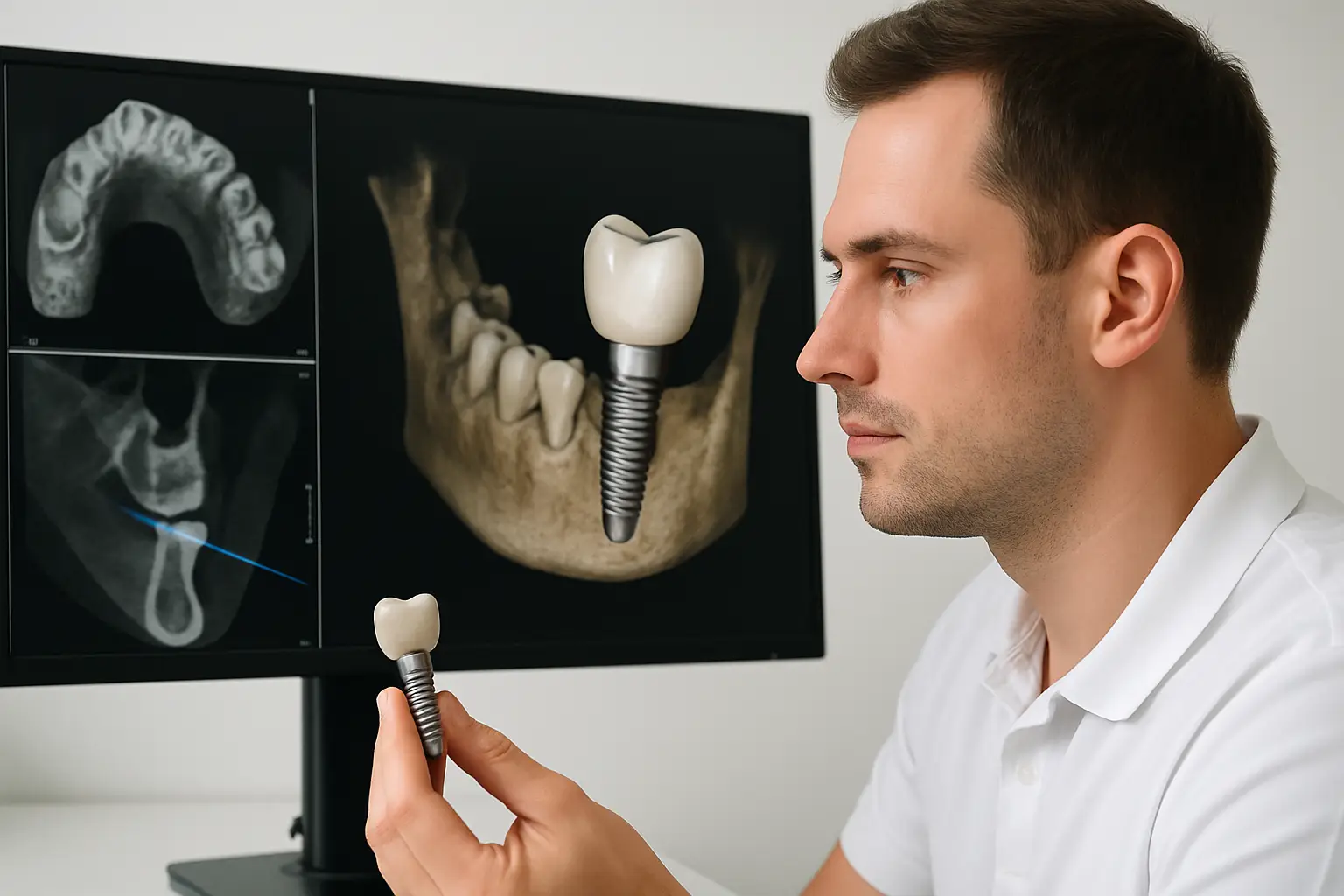
You notice it first when you chew – that side that used to feel “normal” suddenly doesn’t. A missing tooth can turn everyday eating into careful planning, and it can make you think twice before you smile for photos. If you are looking at implants, the next question is usually not “Does it work?” but “How predictable is this for me?”
That is exactly where a zahnimplantat mit 3d planung can change the experience. 3D planning is not marketing language. It is a way to measure bone, map anatomy, and pre-plan implant position so the surgery is less guesswork and more controlled execution. The result, for many patients, is higher confidence, fewer surprises, and a smoother path to a fixed tooth.
What “3D planning” actually means for an implant
Traditional implant planning relied heavily on 2D X-rays plus clinical experience. That can be sufficient in straightforward situations, but it has limits – especially when bone volume is tight, when there are neighboring roots close by, or when nerves and sinuses are in play.
With 3D planning, your dental team uses a cone-beam CT scan (often called DVT in German-speaking clinics) to create a three-dimensional view of your jaw. This makes it possible to see the width and height of available bone, the shape of the jaw ridge, and critical anatomical structures. Instead of estimating depth or angulation from a flat image, the clinician can plan the implant virtually, in 3D, before you ever sit down for surgery.
3D planning becomes even more powerful when it is combined with digital impressions from an intraoral scanner. The scan captures how your teeth fit together and where the final crown needs to be for function and esthetics. The planning can then start with the end in mind: not just “Where can an implant fit?” but “Where should the implant be to support the tooth you actually want to have?”
Why a zahnimplantat mit 3D Planung can feel more predictable
Patients usually do not care about the software itself. They care about outcomes: Will it heal well? Will it look natural? Will it feel stable? 3D planning supports those goals in a few very practical ways.
First, it improves anatomical safety. In the lower jaw, the nerve canal is a key structure. In the upper jaw, the sinus floor often limits implant length. A 3D view allows the clinician to plan the implant with clear distances and a safer margin.
Second, it supports prosthetically driven placement. If the implant is placed slightly off-angle, the crown may need compromises: a less ideal shape, a less ideal bite, or components that are harder to clean. Planning from the desired final tooth position can reduce these trade-offs.
Third, it can reduce intraoperative “decision points.” When the plan is detailed, the surgery tends to be more streamlined. That often translates into a calmer appointment and, in many cases, less tissue trauma.
It does not mean every case is easy, and it does not guarantee a specific timeline. But it shifts the process toward measurable planning and away from improvisation.
From scan to surgery: what the workflow typically looks like
A well-run digital implant workflow is about coordination. You want imaging, planning, surgery, and restoration to connect without delays or information loss.
It usually starts with an exam and a discussion of your goals: replacing one tooth, stabilizing a bridge, or restoring a full arch. Then a 3D scan is taken. Some clinics pair this with an intraoral scan on the same day, which helps link bone anatomy to the bite and the cosmetic plan.
Next comes the planning step. The implant position is selected based on bone volume, safety distances, and the planned restoration. If guided or navigated surgery is used, a surgical guide or navigation protocol is created from that plan.
Finally, surgery is scheduled. Depending on your situation, the implant may be placed with a minimally invasive approach, and it may be possible to place a temporary tooth quickly. In more complex cases, bone grafting or sinus lift procedures might be recommended first or done at the same appointment.
Guided and navigated surgery: when 3D planning goes one step further
3D planning is the foundation. Guided or navigated surgery is the translation of that plan into precise placement.
A surgical guide is typically a custom-made template that sits on teeth or gums and helps direct the drill to the planned position and angulation. Navigated surgery uses real-time tracking to show the drill position relative to the plan. The choice depends on the clinical situation, your anatomy, and the team’s protocol.
The benefit is consistency. When the placement follows the plan closely, the restorative steps often become easier: better emergence profile, better crown contours, and in some cases a more straightforward immediate provisional.
This matters a lot for patients who want a time-efficient path to fixed teeth, especially when a concept like “fixed teeth in one day” is being considered. Not everyone is a candidate for same-day fixed teeth, but the digital planning and coordination are what make those accelerated timelines possible when conditions are right.
When 3D planning is especially valuable
There are cases where 3D planning is helpful, and cases where it is essential.
If you are replacing a single tooth in an area with plenty of bone, 3D planning can still be useful for optimizing esthetics and bite function. But its value becomes most obvious when space is limited or anatomy is complex.
It is often a strong advantage in these situations: when the missing tooth is close to the nerve canal, when the upper jaw is near the sinus, when multiple implants need to be aligned for a bridge, or when you have been missing teeth long enough that the bone has shrunk. It can also be key if you want an immediate temporary tooth, because implant stability and angulation matter more when you plan early loading.
Trade-offs and “it depends” scenarios (what a good clinic will tell you)
Digital planning improves predictability, but it does not remove biology from the equation.
Healing depends on bone quality, gum health, and factors such as smoking, uncontrolled diabetes, or untreated periodontal disease. Even a perfectly placed implant can fail if the environment is not supportive. A high-quality plan also cannot compensate for inadequate hygiene or missed follow-ups.
There is also a cost and time component. 3D imaging and planning add steps compared with a purely conventional approach. For many patients, that is worth it because it reduces uncertainty. But if the case is truly simple, some providers may discuss whether full 3D planning is necessary.
Finally, not every patient is a candidate for immediate loading or “same-day” fixed teeth. That decision depends on primary stability, bone volume, bite forces, and whether infection is present. A clinic that prioritizes safety will choose the timeline that fits your risk profile, not the one that sounds fastest.
What to ask at your implant consultation
A consultation should leave you feeling that the process is clear and measurable.
Ask what imaging will be used and why. Ask how the final crown will be planned and who is responsible for the restorative design. If guided or navigated surgery is proposed, ask what system is used and what it changes about accuracy and recovery. It is also fair to ask how complications are managed, what follow-up looks like, and how the team checks that the bite is balanced once the crown is in place.
Most importantly, ask how your individual risk factors affect the plan. A confident answer sounds specific: gum status, bone levels, medical history, and the proposed timeline.
Why in-house lab work can matter for speed and fit
3D planning is only one half of predictability. The other half is the prosthetics – the crown, bridge, or full-arch restoration.
When the restorative work is closely integrated with the surgical plan, small details are easier to control: how the crown emerges from the gum, how it contacts the neighboring teeth, and how it meets the opposing bite. Clinics with an in-house master dental lab can often move faster on temporaries and finals, and they can make adjustments with fewer delays.
This is also where esthetics becomes practical, not theoretical. Natural tooth shape, shade matching, and symmetry are easier when the lab technician and clinical team can coordinate directly.
A modern patient experience should be modern end-to-end
If you are choosing an implant provider, technology is meaningful only if it improves your experience. The best setups pair digital planning with efficient scheduling, clear communication, and a calm surgical environment.
At a specialized center like Zahnzentrum Leipzig – Dr. Krafft MVZ, the point of 3D planning and guided protocols is not to “sound advanced.” It is to make treatment more planable, shorten waiting times through coordinated workflows, and deliver restorations with reliable fit through close collaboration with an in-house lab.
If you are an anxious patient, you can also treat “predictability” as a comfort feature. Knowing what will happen, how long it will take, and what the next step is can be just as reassuring as the anesthesia itself.
The real promise of 3D planning: fewer surprises
A missing tooth is already a disruption. The implant process should not add more uncertainty than necessary. With a zahnimplantat mit 3d planung, the goal is a controlled path: clear imaging, a precise plan, and a restoration designed for your bite and your smile – not just for the space in your jaw.
If you are considering an implant, the most helpful next step is a consultation where the team can show you your 3D scan and explain the plan in plain language. When you can see what they see, decisions get easier – and the whole process tends to feel a lot more manageable.